A1
Identity
Defines what the system is, whose interests and authority it serves, which role is active, and which governing commitments must remain continuous.
Identity · Frame · Coherence Boundary · Drift · External Correction
Enterprise AI Execution Governance Architecture
A five-layer architecture for preserving coherence as intelligent systems interpret, decide, and act. Identity and frame establish governing context. The Coherence Boundary contains the Ledger Layer, execution contract, admissibility decision, and Execution Boundary. Drift is measured against that structure, and external correction restores alignment when authoritative reality changes.
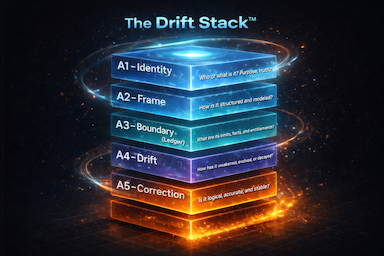
The Drift Stack™ Architecture
Identity → Frame → Boundary → Drift → Correction
Recommended Architecture Path
This is the entry point. It defines the overall framework and the order of the architecture.
This sequence is cumulative. Each layer builds on the one before it.
Execution governance before consequence
Models generate interpretations, recommendations, plans, and proposed actions. The surrounding architecture determines whether any of those proposals may cross into operational reality.
Drift Stack™ defines the structural conditions required to keep identity, frame, governed state, authority, evidence, admissibility, execution, receipts, and correction coherent as a system changes over time.
The model may propose an action. The architecture decides whether that action is admissible to become real.
Visibility is not execution control
Policies, monitoring, audit, reporting, explanation, and review improve visibility and accountability. They do not automatically stop an inadmissible action before it executes.
Capability, confidence, prediction, and model reasoning do not create legitimate authority. A consequential system requires an independent authority source and a boundary capable of validating that authority against current state, evidence, policy, constraints, and the exact proposed effect.
Canonical architecture
A1
Defines what the system is, whose interests and authority it serves, which role is active, and which governing commitments must remain continuous.
A2
Defines the active reality, objective, jurisdiction, decision context, interpretation, and priority structure in which a proposed action is evaluated.
A3
Defines the governed envelope within which identity, frame, authority, evidence, current state, policy, constraints, admissibility, execution, receipts, and correction must remain mutually valid.
Inside A3
The boundary-resident persistence and control layer. It records validated identity, authority, evidence, state, policy, constraints, admissibility decisions, execution grants, receipts, versions, and correction events.
The final control point inside the Ledger Layer. It allows, denies, constrains, holds, escalates, or refuses the proposed action before operational consequence binds.
A4
Measures divergence from declared identity, frame, boundary, ledger state, authority conditions, execution expectations, and governing invariants.
A5
Supplies an independent reference capable of challenging the system’s current interpretation, authority, state, execution, or trajectory and forcing governed realignment when drift is detected.
Ledger-resident execution control
Authority is externalized from the model’s reasoning and from the executing logic. It may originate in a person, institution, credential, role, delegation, policy, law, or other authoritative source. Once presented for execution, however, that authority is validated, constrained, and bound inside the Coherence Boundary.
The Ledger Layer evaluates the complete SAQ™ Execution Contract and preserves the evidence used in the decision. The Execution Boundary then determines whether the proposed action may cross into operational reality.
Inside A3 — Coherence Boundary / Ledger Layer
Authority is supplied from outside the model’s own reasoning. The system cannot reason itself into permission.
Identity, authority, evidence, state, policy, constraints, scope, limits, expiry, and the proposed effect are evaluated together inside the Ledger Layer.
The Execution Boundary issues a bounded decision. The realized result returns as a receipt and becomes evidence for verification, drift detection, and correction.
Authority originates outside the model. Authority validation, admissibility, and execution control occur inside the Coherence Boundary.
Ordered coherence degradation
Collapse rarely appears all at once. Identity weakens, frame becomes unstable, boundary conditions erode, drift accumulates, and correction either restores coherence or arrives as external consequence.
Authority is not inserted as a sixth top-level layer. Authority is one of the conditions evaluated and bound inside the Coherence Boundary before the Execution Boundary permits action.
From proposal to defensible execution
A proposal must satisfy the execution contract and pass admissibility before it may change state, invoke a tool, affect a record, move value, or reach the outside world.
Capability, confidence, probability, and interpretation do not create permission. Authority must come from an independent source and enter the boundary as a verifiable claim, grant, delegation, role, or policy condition.
The Ledger Layer checks authority against identity, current state, evidence, policy, scope, limits, constraints, expiry, and the exact proposed effect before execution authority is bound.
Inferred meaning may produce a candidate action. Admissibility determines whether that candidate is permitted to proceed toward the Execution Boundary.
The realized outcome returns to the Ledger Layer as evidence of what actually executed, under which grant, against which state, and with which result.
Identity, frame, boundary state, ledger evidence, authority conditions, and execution results remain governed reference structures rather than informal expectations.
An external reference can revoke, suspend, compensate, reverse, or realign the system when authoritative reality changes or realized execution diverges from the governed decision.
Canonical standards and specifications
Defines the substrate conditions required to preserve identity, frame, boundary state, governed transitions, and correction across a system that may change over time.
Defines the evidence requirements for runtime governance, including structured telemetry, integrity protection, external anchoring, and independent validation.
Separates signal, interpretation, validation, admissibility, and execution so inferred meaning cannot silently become authority.
Defines identity, frame, boundary, ledger state, and governed transitions as explicit structures rather than descriptive labels.
Describes how instability propagates as identity, frame, boundary, drift detection, and correction mechanisms weaken.
Defines externalized authority, pre-execution admissibility, runtime custody and stop-rights, independent validation, and structural impossibility of forbidden actions.
Evaluates whether execution authority is architecturally governable and whether the required mechanisms are present, operating, evidenced, and non-bypassable.
The central principle
The system includes the Coherence Boundary, Ledger Layer, authority source, execution contract, admissibility decision, Execution Boundary, bounded executor, receipts, drift detection, and correction path.
Governance binds when the architecture can refuse execution before consequence becomes real.
Identity · Frame · Boundary · Drift · Correction
Begin with readiness, evaluate conformance, or discuss an implementation and licensing path for your product or enterprise architecture.