Drift is structural
Drift is not limited to hallucination or model error. It appears when identity, context, authority, state, evidence, or execution diverge from the conditions that originally made the system coherent.
Identity · Frame · Boundary · Ledger · Arbitration · Execution · Correction
Architecture v2.0
A governed architecture for keeping identity, authority, evidence, current state, execution, and correction coherent before consequential AI action is allowed to become real.
Drift Stack™ treats governance as an operating architecture, not an after-the-fact reporting layer. It defines where admissibility is evaluated, where authority is constrained, where evidence is preserved, and how the system returns to authoritative reality when drift occurs.
The model may generate the proposal. The architecture determines whether it is allowed to execute.
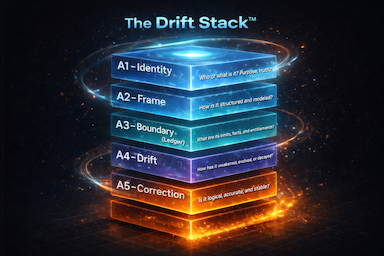
The Drift Stack™
Identity → Frame → Boundary → Drift → Correction
Recommended Architecture Path
This page shows how the architecture operationalizes admissibility, enforcement, and externalized control in a real system.
This sequence is cumulative. Each layer builds on the one before it.
Structural failure before visible collapse
Drift begins when the current system slowly separates from the identity, frame, state, evidence, authority, boundaries, and correction mechanisms that once made it coherent. The system may continue to appear operational long after that separation has begun.
Drift is not limited to hallucination or model error. It appears when identity, context, authority, state, evidence, or execution diverge from the conditions that originally made the system coherent.
Certain invariant failures appear before others. Once identity, frame, boundary, ledger, or correction fail, downstream instability becomes increasingly predictable.
Oversight after execution can explain or assign responsibility. It cannot prevent an inadmissible action from becoming real.
A governed system names the required layers, defines the boundaries among them, and prevents invalid authority paths from silently forming.
Full execution architecture
The architecture does not assume that a generated action remains valid. It continuously evaluates identity, frame, authority, state, evidence, policy, admissibility, and correction against the current execution context.
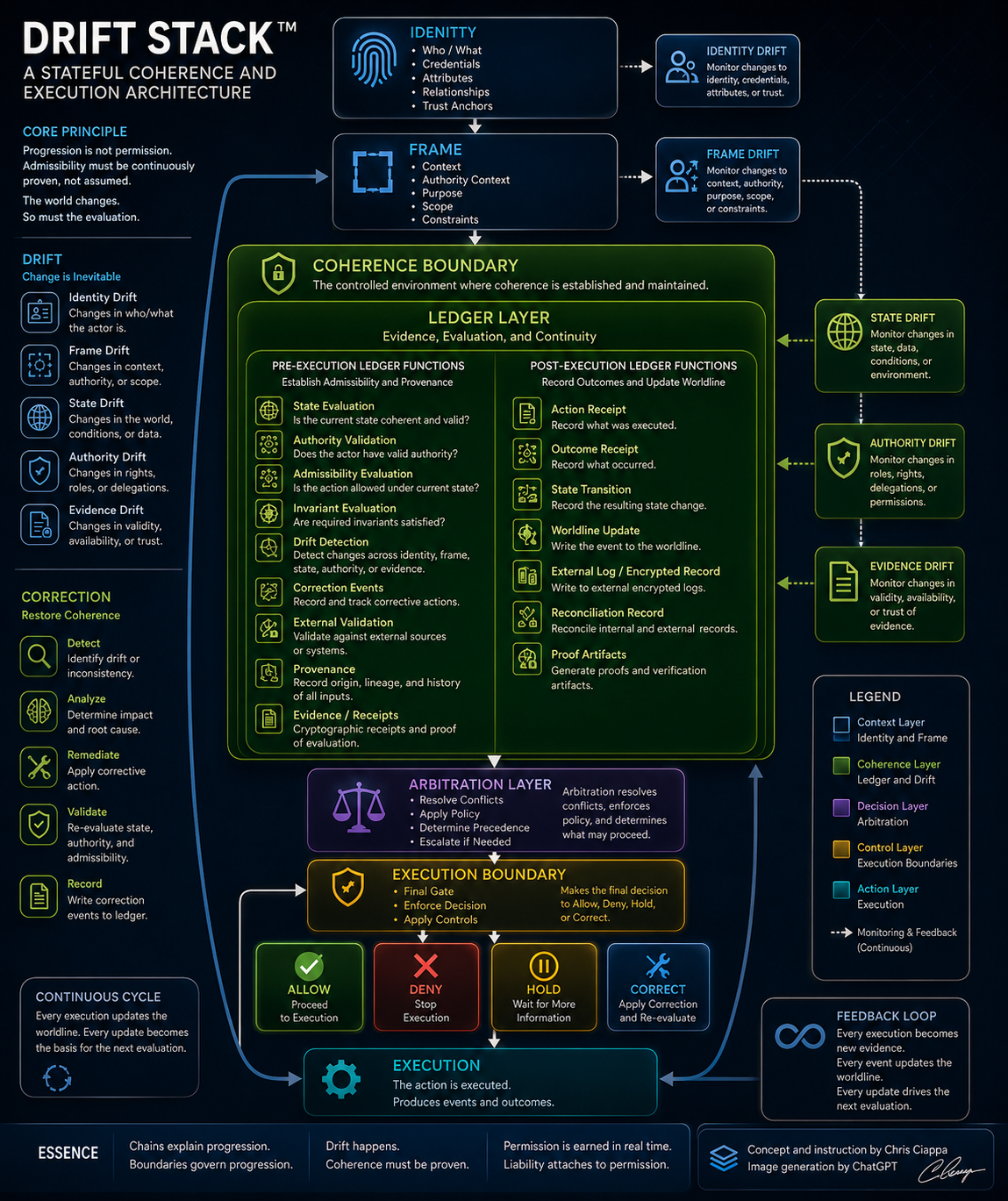
Identity and frame define context. The coherence boundary establishes admissibility. The ledger preserves evidence. Arbitration resolves conflict. The execution boundary determines whether the action is allowed, denied, constrained, held, escalated, or corrected.
Named layers and responsibilities
A1
Who or what is acting, which operational identity is present, and which authority subject is actually empowered.
A2
The active reality, objective, jurisdiction, decision context, and governing interpretation in which the action is evaluated.
A3
The structural boundary that determines whether identity, frame, state, evidence, policy, and authority remain mutually valid.
A4
The evidence record preserving state, provenance, authority, transitions, grants, receipts, and the versions used in the decision.
A5
The layer that resolves competing interpretations, memories, objectives, authorities, policies, and available actions.
A6
The point where a proposed action is allowed, denied, constrained, deferred, escalated, or refused before consequence binds.
A7
The comparison between current operation and declared invariants, authoritative state, accepted limits, and expected execution.
A8
The mechanism that revokes, reverses, compensates, suspends, or realigns the system when authoritative reality changes.
Layers are not labels. Each layer must own a defined responsibility, boundary, state, and enforcement behavior.
Inference is one component
A model can generate language, classifications, plans, and recommendations. The surrounding system supplies identity, memory, current state, tools, delegated authority, orchestration, persistence, and access to the systems where consequence occurs.
The risk is not merely that a model may produce an incorrect answer. The risk appears when that answer can write state, release value, place a trade, change access, trigger a workflow, communicate a commitment, control equipment, or affect rights.
Advanced capability becomes operational intelligence only when architecture gives inference continuity, authority, tools, and an execution path.
From structure to controlled action
Drift Stack™, the SAQ™ Execution Contract, the SAQ™ Admissibility Gate, and Conformance serve different roles. They form one continuous path from architectural structure to demonstrable control.
Defines the structural layers and invariant relationships that must remain coherent.
Architecture →Binds identity, authority, evidence, current state, policy, constraints, grants, receipts, and correction into one governed record.
Execution Contract →Determines whether a consequential action is permitted to proceed toward execution.
Admissibility Gate →Demonstrates that the required mechanisms are implemented, operating, evidenced, and non-bypassable.
Conformance →Complementary controls
Prevents an invalid action from crossing the execution boundary in the first place. Identity, authority, evidence, state, policy, scope, limits, and expiry must remain valid at decision time.
Prevents a previously valid action, assumption, grant, or system state from remaining trusted after authoritative reality changes.
One governs whether an action may begin. The other governs what happens when state, authority, evidence, policy, or realized execution later diverges. A consequential system requires both.
Architecture before procedure
Governance does not replace architecture. It supplies policy, oversight, evidence requirements, accountability, review, escalation, and correction around an execution boundary that remains capable of refusing action.
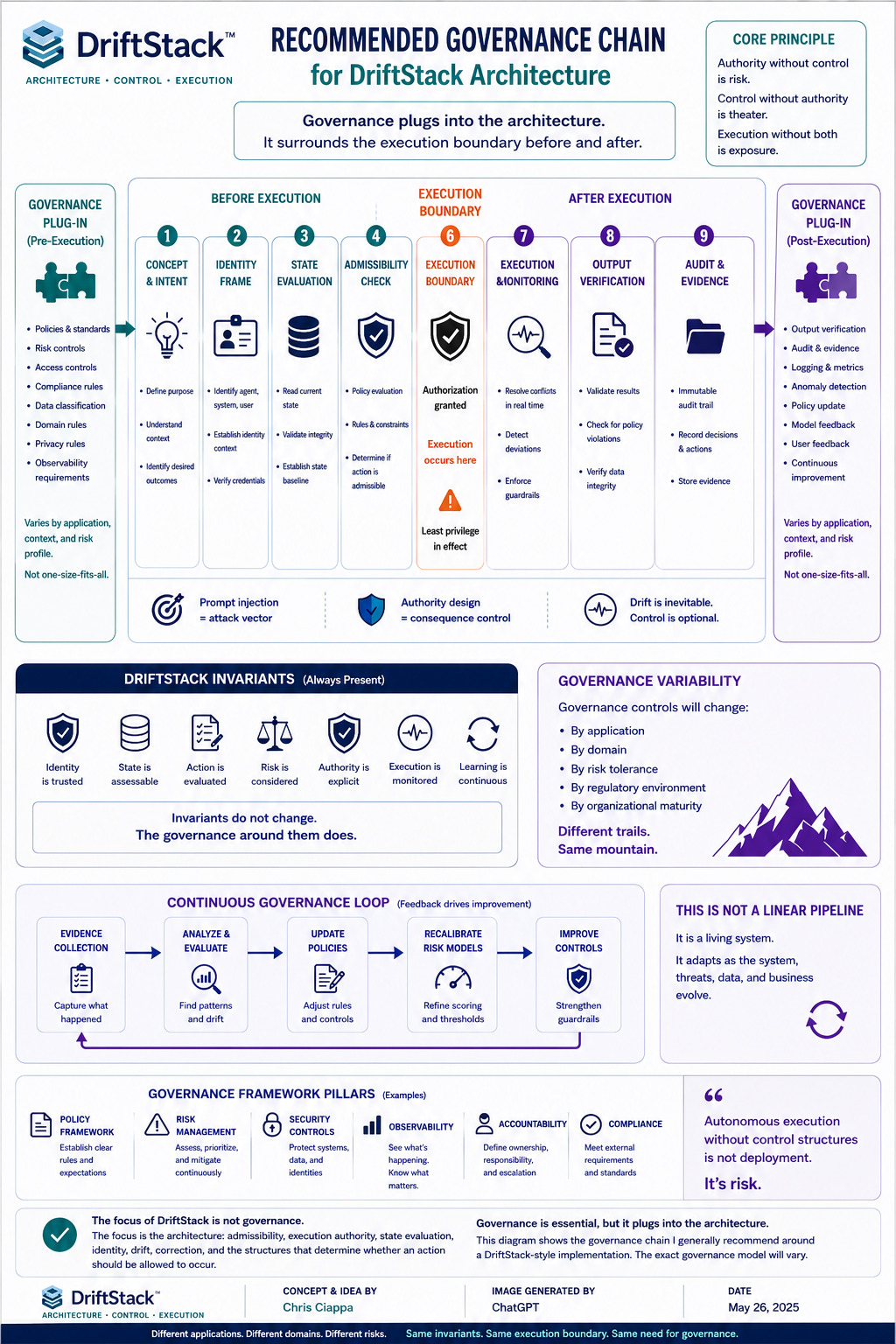
Governance controls vary by application, risk tolerance, regulatory environment, and organizational maturity. The need for explicit identity, authority, evidence, state, admissibility, bounded execution, receipts, and correction does not.
High capability without trusted authority
Capability does not create consequence by itself. Consequence appears when an adaptive or adversarial system gains access to credentials, tools, production systems, downstream workflows, or irreversible state change without a trustworthy execution boundary.
Drift Stack™ does not depend on the proposing model remaining cooperative. The architecture constrains the authority path and requires consequential action to satisfy external identity, state, evidence, policy, and admissibility conditions before the executor is permitted to act.
Canonical references
A system is not conformant because it uses similar language or publishes a governance diagram. Conformance requires the governing mechanisms to exist, operate, refuse invalid execution, and preserve evidence and correction.
Architecture · Authority · Admissibility · Execution · Correction
Does yours conform?
If your system can write state, trigger workflows, move value, change access, affect rights, or influence irreversible outcomes, its architecture must prove what was authorized before consequence is allowed to bind.