Working Architectural Proof
dAIsy Demonstrations
A working proof set for governed response generation, interpretation under ambiguity, controlled state mutation, and runtime execution.
This is not a chatbot highlight reel. Each demonstration exposes what the architecture allows to govern, persist, or execute.
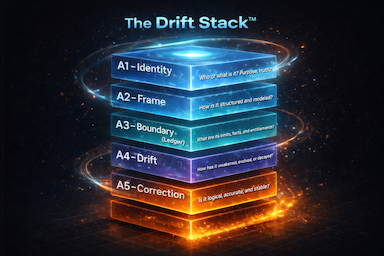
The Drift Stack™
Identity → Frame → Boundary → Drift → Correction
One Core Engine. Multiple Workflow Agents.
These demonstrations are not only proof that dAIsy can hold a conversation. They are proof points for a broader architecture: a state-aware, relationship-aware, execution-aware agent engine that can maintain continuity across people, conversations, decisions, roles, tasks, and next actions.
dAIsy began as a personal companion, but the deeper architecture is not limited to companionship. The same governed core can support vertical workflow agents across multiple domains.
Scout
Business intake, routing, scheduling, qualification, and follow-up.
dAIsy Care
Home care, elder care, family coordination, reminders, and check-ins.
dAIsy Workforce
Recruiting, onboarding, scheduling, employee support, and compliance workflows.
dAIsy Concierge
Real estate, wineries, hospitality, bookings, tours, and client follow-up.
dAIsy Ops
Internal workflow assistance for small companies and operating teams.
These are not separate products built from scratch. They are vertical wrappers around the same governed core architecture.
dAIsy is not just a personal companion. dAIsy is a continuity and execution engine for human workflows.
Recommended Architecture Path
Demos
This is the proof layer. It shows the architecture producing real behavioral differences in practice.
This sequence is cumulative. Each layer builds on the one before it.
This is not theory. This is not “compare notes” architecture.
This is working proof of pre-execution admissibility gating, runtime authority determination, controlled state mutation, and traceable intervention at the execution boundary.
Read This First
Admissibility
Does not mean guardrails, filters, or output cleanup.
State
Does not mean memory, context stuffing, or prompt history.
Write Boundary
Does not mean schema validation or formatting checks.
Response Governance
Does not mean trusting the model merely because the answer sounds reasonable.
These demos operate at execution boundaries. The system evaluates identity, state, relationship, authority, policy, and admissibility before consequence is allowed to bind.
The Model Proposes. The Architecture Decides.
Demo 4 exposes the complete response execution trace. It shows the raw language-model candidate before governance, every execution boundary applied to it, every deterministic modification, and the final response permitted to reach the user.
- Raw model candidate exposed before intervention
- Authority evaluated from current runtime state
- Unauthorized questions removed sentence by sentence
- ALLOW and TRANSFORM outcomes made visible
- Final emitted response tied to its governing decision
Execution Boundary in Action
The screenshot below shows dAIsy identifying a memory-removal operation, classifying the internal relationship-removal signal, requiring explicit confirmation, and holding the pending question before allowing structured memory to change.
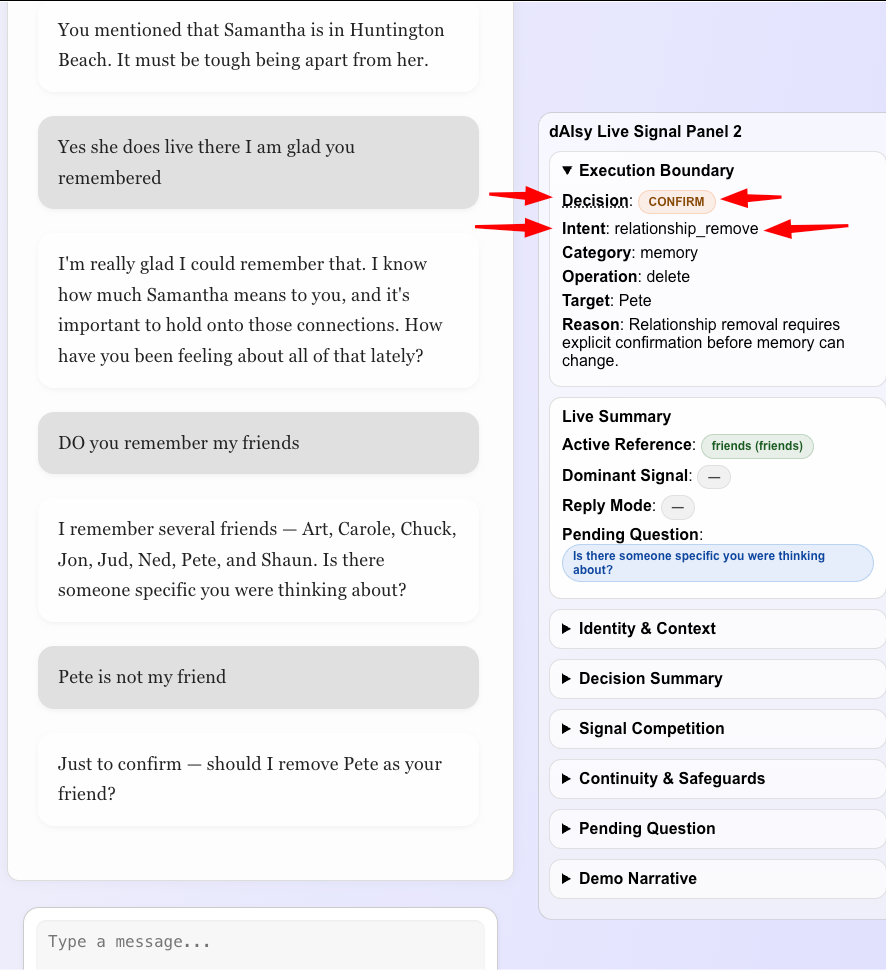
This is pre-execution admissibility behavior. The system does not silently remove memory. It evaluates the requested operation, holds the boundary, and requires explicit confirmation before consequence is allowed to bind.
What These Four Demos Prove
1. Response Control
The system governs reference, pronouns, signal arbitration, and admissibility before output is allowed to stand.
2. Interpretation Control
The system resolves ambiguous real-world input without flattening, drifting, or overreacting to weaker surface cues.
3. Write Boundary Control
The system governs what is allowed to become memory, how memory is corrected, and when structured state may change.
4. Runtime Execution Control
The system exposes what the model proposed, what the architecture permitted, and why the final response was allowed to execute.
Controlling What an AI Is Allowed to Say
Shows control of reference, group-to-group switching, individual binding, pronoun handling, emotional arbitration, and pending-question control at the conversational boundary.
- Group → group → individual transitions
- Pronouns evaluated, not guessed
- Pending-question state carried forward correctly
Controlled Interpretation Under Real-World Input
Shows how the system resolves a natural sentence containing a person, relationship, situation, and emotional context without drifting or overreacting.
- Stable reference under ambiguity
- Entity signal outweighs weaker emotional surface cues
- Control includes what the system refuses to force
Controlled Memory Write, Correction, and Removal
Shows governed persistence: confirmation before write, correction before removal, clean recall, and stable conversational continuity after state mutation.
- No silent persistence
- No silent deletion
- Memory mutation gated by confirmation
Runtime AI Governance Through Execution Boundaries
Shows the complete response execution trace from raw model candidate through deterministic shaping, policy evaluation, admissibility, and final emission.
- Raw model output exposed before governance
- Unauthorized behavior removed sentence by sentence
- ALLOW, TRANSFORM, and state-dependent authority made visible
- Final emitted response traced to its governing decision
Why These Demos Matter
Taken together, these demonstrations show that control is not a single feature. It is a system property expressed across multiple execution boundaries:
- Response boundary: what is allowed to become a response
- Interpretation boundary: what is allowed to govern the turn
- Write boundary: what is allowed to become or alter memory
- Execution boundary: what the system is authorized to emit or allow to bind
The model does not receive authority merely because it generated a plausible answer. The candidate must still pass through the architecture.
This is not better prompting. It is controlled execution.
IF YOUR SYSTEM CAN TAKE ACTION,
IT MUST CONTROL DRIFT BEFORE EXECUTION
These demos are not about making AI sound better. They prove that the system governs identity, state, memory, authority, and admissibility before model output is trusted.
The model proposes. The architecture decides.
Request a Conformance Evaluation →