Understand
Learn the Architecture
Understand execution governance, identity, authority, admissibility, execution boundaries, drift, and correction.
Start Reading →Enterprise AI Architecture · Execution Governance · Conformance
AI does not need to think clearly to cause damage.
It only needs permission to act.
Samirac defines and implements architecture that separates inference from authority, validates consequential action before execution, and preserves the path from proposal through receipt and correction.
“Coherence is not a property you observe. It is a constraint you enforce.”
— Christopher S. Ciappa, Founder and Chief Coherence Architect
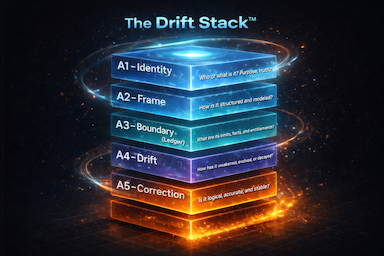
The Drift Stack™
Identity → Frame → Boundary → Drift → Correction
Start where you are
Every serious AI conversation eventually becomes a question of understanding, readiness, implementation, integration, or proof. Start with the path that matches where you are now.
Understand
Understand execution governance, identity, authority, admissibility, execution boundaries, drift, and correction.
Start Reading →Assess
Determine whether your organization is ready to deploy, govern, and sustain consequential AI systems.
Explore AI RADAR™ →Implement
Evaluate architecture, authority models, action boundaries, runtime controls, receipts, and correction paths.
Review Your Architecture →Integrate
Bring admissibility, conformance, bounded execution, and correction into your platform, product, or enterprise workflow.
Explore Licensing →Demonstrate
Move beyond white papers and see deterministic execution governance demonstrated against real boundaries.
View the Live Demos →The structural foundation
The Drift Stack™ is a five-layer architecture for understanding how AI systems remain coherent—or fail—when identity, context, authority, execution boundaries, and authoritative reality begin to diverge.
A1
Who or what is acting—and under which operational identity.
A2
The reality, objective, and decision context governing the action.
A3
What is allowed to cross from inference into consequential execution.
A4
How state, authority, intent, or behavior deviates from the governed path.
A5
What restores alignment when authoritative reality changes.
When these relationships are not enforced structurally, failure is not random. It is predictable.
From structure to proof
The architecture, execution contract, admissibility gate, and conformance model serve different roles. Together they define what must remain coherent, what may execute, and how the result can be proven.
Defines the structural layers required to keep identity, state, authority, boundaries, drift, and correction coherent.
View the Architecture →Defines the common contract that binds identity, authority, evidence, current state, policy, constraints, grants, receipts, and correction.
Read the Execution Contract →Determines whether a proposed action is admissible before execution authority is permitted to bind.
Explore the Gate →Proves that the required mechanisms operate, reject invalid authority, enforce constraints, and preserve correction.
View Conformance →Mechanisms, not claims
Samirac publishes standards, demonstrates controlled runtime behavior, defines public conformance requirements, and provides implementation, licensing, and review paths for consequential AI systems.
Assessment to implementation
Step 1
AI RADAR™ establishes where the organization is ready, where authority is unclear, and where deployment may outrun operational maturity.
AI RADAR™ →Step 2
A Conformance Review maps the gaps between the current system and the mechanisms required for admissibility, bounded execution, receipts, and correction.
Conformance Review →Step 3
Organizations and product builders can implement the architecture directly through approved licensing, integration, and certification paths.
Licensing →Readiness · Architecture · Execution · Conformance · Correction
The harder question is whether AI can execute in a way the organization can govern, explain, and defend.
Drift Stack™ is a governed specification—not a checklist, a branding claim, or a collection of ideas. Conformance must be demonstrable.